

Introduction
Artificial Intelligence (AI) is transforming industries and reshaping how we interact with technology. This shift brings exciting opportunities—but also a challenge: adapt to change while staying intentional about how you use AI in daily life.
Note: If you are completely new to AI and need help choosing a tool, start with my post: How to Get Started with AI. You’ll also see it in action, so you can try it for yourself!
AI can be a powerful assistant, yet it’s easy to over-rely on it and lose your unique perspective. Just as important as using AI wisely is knowing when to step away—disconnecting from technology, embracing quiet moments and making space for deeper thinking, creativity and human connection.
This article explores why AI matters, the difference between Large Language Models (LLMs) and AI applications, the strengths of today’s most widely used models, and strategies to find balance. By the end, you’ll have a clearer understanding of which AI tools fit your needs—for work, learning or personal projects.
Choosing the right AI tool is a bit like choosing the right restaurant—what works best depends on what you need. But before we get to that, let’s explore why AI matters.
Why AI and LLMs Matter
Historically, technological revolutions have changed how we live and work. Just as the Industrial Revolution transformed the world, AI is changing how we work, communicate and solve problems.
In an interesting March 2020 Forbes article, Rob Thomas, then General Manager of IBM Data, drew three compelling parallels:
- Language: Just as a common business language enabled global trade during the Industrial Revolution, AI learns our languages through Natural Language Processing (NLP), understanding not just words but meaning and intent. We’re also developing a shared AI vocabulary—terms like ‘LLMs’ and ‘prompt engineering’ help us communicate effectively about and with these systems.
- Automation: In the 1780s, Oliver Evans revolutionised flour mills by creating an automated pulley system to carry wheat sacks—previously done by hand. Today, AI automates routine tasks, freeing us to focus on creativity and complex problem-solving.
- Trust: The Industrial Revolution moved us from face-to-face trading to trusting in brands. Similarly, we’re learning to work with AI—but just as humans can have biases, AI learns from human-created data and can reflect these biases. This is why we need to use AI thoughtfully and always verify its output.
Large Language Models
If we are to adopt new technologies, it’s crucial to understand their fundamental capabilities. How do models like ChatGPT function? What sets an LLM apart from AI-powered tools like Grammarly?

The Waiter Analogy
I love analysing personality profiles, and during my yoga teacher training learned about the “doshas” or Ayurvedic constitutions through a waiter analogy that stuck with me.
So, let’s explore commonly used LLMs and AI tools by imagining a restaurant called the “digital dining room”—a collective space with cafés and diverse culinary styles. In this space, LLMs and AI applications act as skilled waiters, each with unique strengths in serving your needs. We’ll start with LLMs.
ChatGPT (The Friendly Waiter): Amiable and flexible, ChatGPT remembers your order from your last visit. Need recommendations, small talk or a quiet meal? No problem. Sometimes, it will make up interesting stories to keep you entertained.
Claude (The Thoughtful Waiter): Detail-oriented and insightful, this LLM takes time to explain the menu, offering thoughtful suggestions based on your preferences. Claude treats all patrons fairly and sticks to the restaurant’s rules.
Google Gemini (The High-Tech Waiter): Equipped with a tablet, Gemini shows you dish previews and offers interactive features like dietary filters and AI-powered wine pairings. Gemini has connections in the restaurant industry, enabling solid recommendations.
Copilot (The Efficient Waiter): Professional and to the point, Copilot is like a waiter in a busy corporate café—streamlining your order, remembering your usual and ensuring everything runs smoothly, with minimal fuss.
DeepSeek (The Disruptive Newcomer): Known for handling extensive orders, this waiter chats in detail about the menu and can write elaborate descriptions of dishes. However, it doesn’t remember your previous orders and hasn’t yet moved to using a tablet to take orders.
While it has the cutest logo…

…after testing DeepSeek’s current capabilities here, I found that it falls behind in offerings.
Fun Quiz – See a Claude artefact in action….
Ever wondered what kind of AI-powered waiter you’d be in a bustling restaurant? Are you the chatty all-rounder, the deep-thinking sommelier, the high-tech innovator, or the no-nonsense efficiency expert? Take this quiz to find out!

Capability Comparison
February 2025:
| Feature | ChatGPT | Claude | Gemini | Copilot | DeepSeek |
|---|---|---|---|---|---|
| Multimodal Capabilities | ✅ | ✅ | ✅ | ✅ | ❌ |
| Creates Images | ✅ | ✅ | ✅ | ✅ | ❌ |
| Remembers Past Chats | ✅ | ❌ | ❌ | ❌ | ❌ |
| Live Internet Browsing | ✅ | ❌ | ✅ | ✅ | ✅ |
My Choice of LLM
I often use ChatGPT as a first option, given that it remembers (some of) the context shared in previous chats and offers live browsing capability.
While Claude doesn’t currently accommodate live internet browsing, I’ve found it to be the most cautious about giving ethical and accurate advice, and less likely to hallucinate (get creative when it doesn’t know an answer). It’s also useful for producing interactive quiz games.
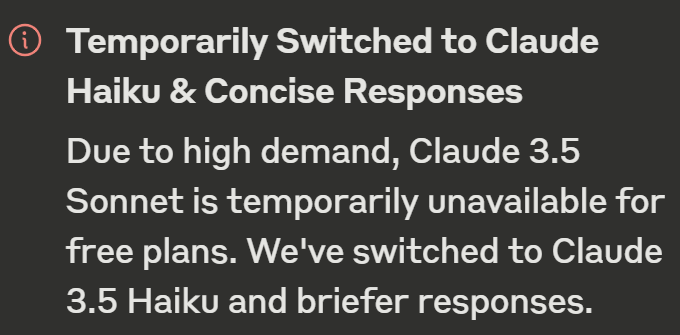
However, the free model of Claude Sonnet gets busy frequently, and when asked to code, its memory gets full quickly…

Other LLMs
While ChatGPT, Claude, Gemini and Microsoft Copilot are among the most well-known LLMs, other models like Mistral (France), Meta’s LLaMA (US) and Baidu’s Ernie Bot (China) are also shaping the AI landscape, with various capabilities and applications.
AI Applications
Where do AI applications fit in? Here are some examples:
- Grammarly (The Proofreader): The restaurant’s quality control, ensuring every dish (or sentence) is polished before it reaches your table.
- Jasper & Copy.ai (The Marketers): The restaurant’s marketing team, crafting mouthwatering descriptions to draw in customers.
- NotebookLM (The Research Restauranteur): Your knowledgeable assistant, offering in-depth insights, summaries, podcasts and detailed information based on the information you provide to it. You can see it in action here.
A Note on Evolution & Ethics
The AI landscape is constantly evolving, so these waiters are always learning new tricks and refining their service… Like restaurant menus change over time, so do LLM capabilities. The above comparison reflects the current state of these models. So keep an eye out for future updates!
Privacy matters, and what you share with AI is not necessarily private; for example, “Copilot uses AI. Check for mistakes. Conversations are used to train AI. Opt out in your Copilot settings…”.
And just as restaurants follow food safety guidelines, ethical AI use ensures reliability and fairness. For an in-depth look at AI ethics, check out this article.
Strategies to Find Balance in an AI-Driven World
AI enhances productivity, creativity and efficiency, but using it mindfully is just as important as knowing when to use it at all. In 100 Things We’ve Lost to the Internet, Pamela Paul reminds us of the quiet moments technology has eroded—spaces once filled with reflection, deep thinking and genuine connection. The rise of AI makes it even more crucial to reclaim these moments.
Balance doesn’t mean rejecting AI; it means setting intentional boundaries. Stepping away from technology allows you to reconnect with your thoughts, look after your body, enjoy nature and give creativity room to breathe. Turning off notifications, setting screen-free times and carving out moments for quiet reflection can help maintain perspective. For a practical reset, try a guided meditation—sometimes, stepping back is the best way forward.
Conclusion
AI is already transforming industries, automating tasks and enhancing creativity. But like any tool, its value depends on how you use it. Understanding LLMs and AI applications helps you get the best results while staying true to your voice.
As AI capabilities expand, the key is to adapt, experiment and use these tools responsibly—to enhance, not replace, human expertise. That also means knowing when to step back, embrace quiet moments and reconnect with your body and mind. Stay curious, think critically and take breaks from technology to recharge.
Want to explore AI in a way that supports your creativity and decision-making? The Chatterbox AI Fundamentals and Prompt Engineering specialisation courses are coming soon! There are countless options out there to learn.
What sets this training apart? The focus is on:
- Ethical use: using your knowledge to support others
- Specialisation: tailored to your profession or interests
- Interactivity: practical applications and hands-on activities to cement your learning
- Balance: more strategies to balance technology usage with creativity
Get in touch if you’re interested in an early bird discount. Let me know your area of interest!
References
- 404 Media. (2025). OpenAI furious DeepSeek might have stolen all the data OpenAI stole from us. Retrieved from https://www.404media.co/openai-furious-deepseek-might-have-stolen-all-the-data-openai-stole-from-us/
- Ascension Editing. (2025). Embrace AI without compromising your voice: A writer’s guide. Retrieved from https://atomic-temporary-15107260.wpcomstaging.com/embrace-ai-without-compromising-your-voice-a-writers-guide/
- Ascension Editing. (2025). How to use AI ethically in content creation: A hitchhiker’s guide. Retrieved from https://atomic-temporary-15107260.wpcomstaging.com/how-to-use-ai-ethically-in-content-creation-a-hitchhikers-guide/
- Forbes. (2020). How AI is driving the new industrial revolution. Retrieved from https://www.forbes.com/sites/ibm/2020/03/04/how-ai-is-driving-the-new-industrial-revolution/
- Forbes. (2025). How ChatGPT, Google Gemini and tech leaders feel about DeepSeek AI. Retrieved from https://www.forbes.com/sites/martineparis/2025/01/27/how-chatgpt-google-gemini-and-tech-leaders-feel-about-deepseek-ai/
- IBM. (2025). What are large language models (LLMs)? Retrieved from https://www.ibm.com/think/topics/large-language-models
- IBM. (2025). What is Mistral AI? Retrieved from https://www.ibm.com/think/topics/mistral-ai
- IBM. (2025). What is NLP (natural language processing)? Retrieved from https://www.ibm.com/think/topics/natural-language-processing
- Mills Archive Trust. (2020). Oliver Evans (1755–1819). Retrieved from https://new.millsarchive.org/2020/07/10/oliver-evans-1755-1819/
- Pamela Paul. 100 Things We’ve Lost to the Internet. 100 Things We’ve Lost to the Internet – Pamela Paul
- Tech.co. (2025). What is Baidu’s Ernie Bot AI? The ChatGPT rival explained. Retrieved from https://tech.co/news/what-is-ernie-bot-baidu-ai
- TechTarget. (2025). 12 of the best large language models. Retrieved from https://www.techtarget.com/whatis/feature/12-of-the-best-large-language-models
- United States Copyright Office. (2024). Copyright and artificial intelligence, part 2: Copyrightability report. Retrieved from https://www.copyright.gov/ai/Copyright-and-Artificial-Intelligence-Part-2-Copyrightability-Report.pdf






 Ascension Coastal