Not there to criticise or scratch, the editor takes another person’s words and makes them beautiful; makes them sing … with the correct pitch and tone and perfect clarity. You get rid of any fluff and red spots. Then you skilfully mend the little nicks and catch the stray threads, such that any repairs become invisible and you deliver a tailor-made garment that is unique to the author.
But when your day is more a clump of coal than a diamond, you miss half of the wayward threads, don’t spot the dirt on the sleeve and forget to shear the fluff from the collar. So the thread runs even more; the cat grabs it and there goes half the edging. It doesn’t matter that all the other holes were fixed. Imperfection is disaster to an editor; your ballad becomes a blather and your author doesn’t want to wear your stinky design. So you sharpen your tools, shake the fuzz from your ears, dislodge the needle stuck in your head and put a thread through it once more. And start to plan your career change.
I wonder if CTM in Brookvale, Sydney Australia, still has NO PICK UP’S ON SATURDAY’S.
Misuse of the apostrophe is common and give a negative impression of an author’s writing skills…
(from http://www.apostropheabuse.com/) – Richard writes: Here's some real exclusivity! A bookstore in Mt. Eden, Auckland, New Zealand is holding a festival for one writer and one reader. I wonder who the lucky pair were.
Here are some rules that are not difficult to remember.
Expressions of Time
It was previously conventional to use an apostrophe in expressions of time involving a plural reference, such as:
Six weeks’ time
Three months’ wages
The apostrophe is now often left out, i.e.:
Six weeks time
Three months wages
The sense of these phrases tends to be more descriptive than possessive.
When the time reference is in the singular, however, the apostrophe should be retained to help mark the noun as singular:
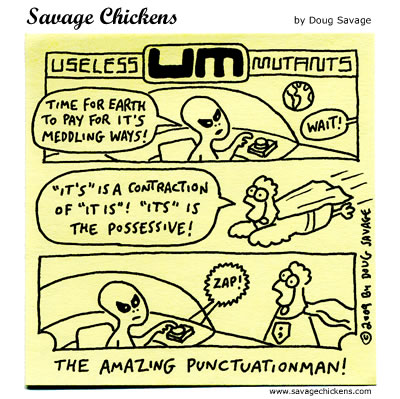
It’s the cat’s habit to chase its tale (this is a cat with character). It is: it’s. The nose belongs to it: its nose.
1. It’s = It is
2. Its = belonging to it
Numbers and dates
Numbers and dates, such as in his 60s, fly 767s, during the 1980s—All the regional style manuals including the Chicago Manual (2003) agree on this [no apostrophe]. Apostrophes are usually there in the plural of single numbers, as in All the 2’s and 3’s were missing.
If there are two or more owners, add ‘s’ then an apostrophe.
Ownership
Acknowledgement of others’ views… (Plural ‘others’—the views belonging to others)
The candidates’ views were not considered. (Plural of candidate)
If there’s one owner, add an apostrophe and then ‘s’.
… initiatives or strategic ways in which the successful candidate’s learning could be leveraged.
The exception to this rule is:
For words which form their plural by changing internal letters (instead of adding ‘s’), the apostrophe comes before the ‘s’.
It was the children’s turn to wash up.
Some other words which follow this rule are: men, women, people.
Joint ownership or association is shown by placing the apostrophe -s on the second of the two owners;
His mother and father’s legacy
Rutherford and Bohr’s atom
In contrast, where the ownership is not joint, each name takes and apostrophe;
Hello! I’m Annie Smit, trading as Ascension Editing. This site offers writing tips for those interested in current Australian standard editing practice (as well as some UK and US preferences on English grammar and style).
‘All living languages exist in a state of tension between growth and decay. Languages change because playfulness and the desire to impress are universal human traits; they grow in response to technological innovation, cultural contact and social developments. Working against these impulses to the new are the forces of stability: inertia, the fear of being misunderstood, and the fixative effect of writing.’
‘Spelling is not important in itself, but it is a social marker enabling those who can spell to look down on those who can’t.’
‘Remember that literacy is an accident of birth and does not confer superior wisdom or virtue.’


 Ascension Coastal